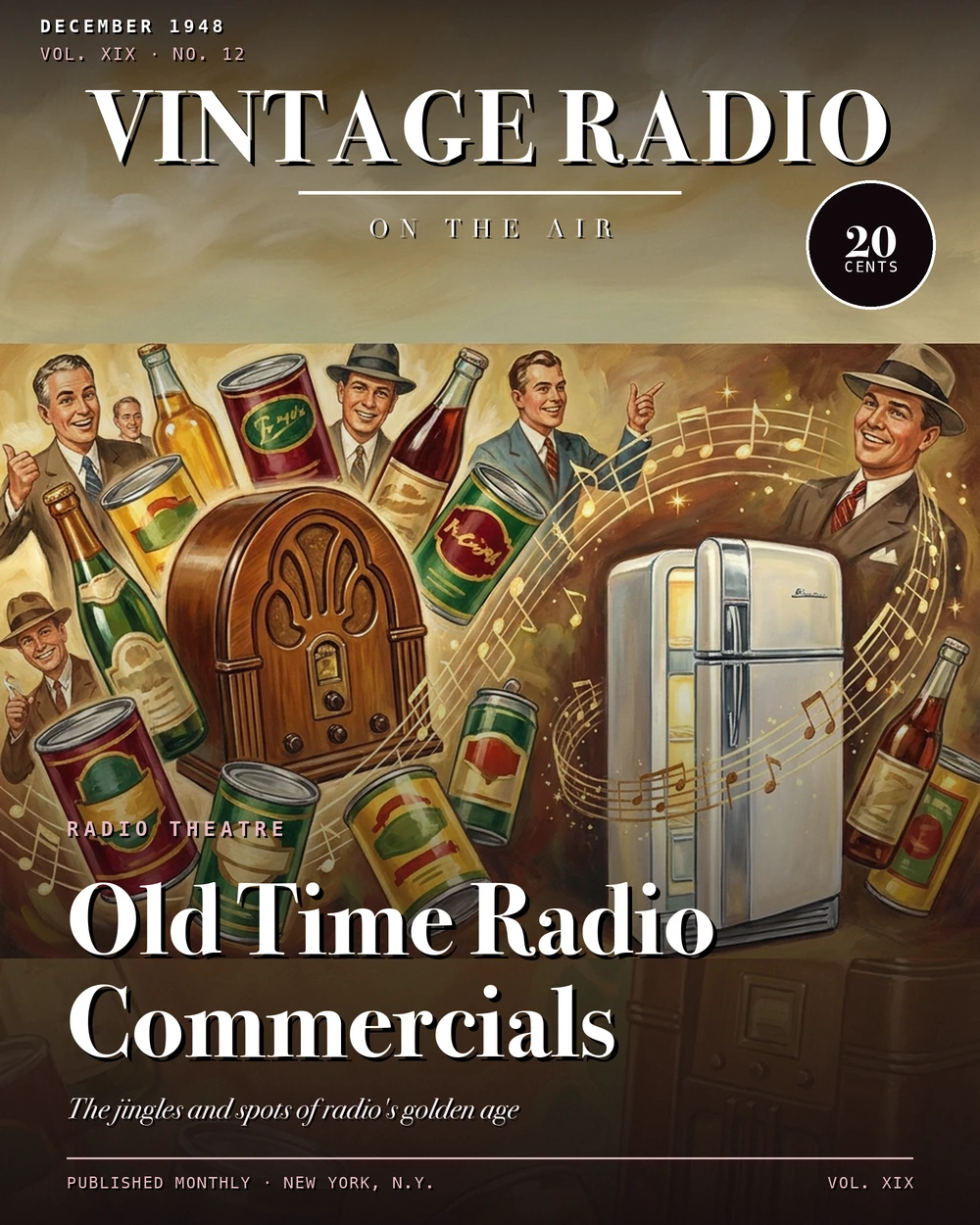
Old Time Radio Commercials
The Business That Built Radio
Before there was programming, there was a problem: who would pay for the airwaves? American broadcasting solved that question in a particular way, and the answer shaped everything that followed. On August 28, 1922, the first paid radio commercial aired on New York's WEAF station, owned by AT&T, promoting the Queensboro Corporation's real estate development in Jackson Heights, Queens. The spot cost $50 to air and ran approximately ten to fifteen minutes — a far cry from the thirty-second punches that would define the medium decades later. That single transaction established the commercial model for American radio, and in a sense, for American broadcasting as a whole.
AT&T had introduced what it called "toll broadcasting" at WEAF in February of that same year — the idea that businesses could purchase blocks of air time and fill them however they liked. The concept spread slowly at first. Radio advertising was not immediately embraced; by the late 1920s, however, most U.S. stations were carrying commercially sponsored programming. By 1929 there were twelve million radio sets in use across the country and 630 stations competing for listeners and sponsors alike. The audience was there. The advertisers followed.
How Sponsors Ran the Show
During the Golden Age of Radio — roughly the 1930s through the 1950s — advertising didn't just fund programming; it was woven into the fabric of it. Sponsors commonly underwrote entire programs, and many of the era's most popular shows were remembered as much by their backer's name as by their own title. The Johnson Wax Program with Fibber McGee and Molly, The Camel Caravan, The Lux Radio Theatre — the sponsor and the show were practically inseparable brands. If you tuned in to your favorite comedy or drama each week, you were also tuning in to a particular soap, cigarette, or car company.
The business mechanics behind this ran on a simple but effective model: radio time was sold in blocks — quarter-hour, half-hour, and full-hour segments — and the sponsor was responsible for filling that time with content. Leftover or unsold time eventually gave rise to shorter "spot advertisements," the precursor to the standalone commercial as we know it today. The soap opera genre even takes its name from this era, a direct tribute to the washing and hygiene product companies — Procter & Gamble, Colgate-Palmolive — that dominated daytime radio drama sponsorship. Product advertising wasn't just adjacent to Golden Age radio. It was structural to it.
The Art of the Jingle
If sponsored programming was the financial engine of radio, the advertising jingle was its most durable creative achievement. The form has a surprisingly specific origin: on Christmas Eve, 1926, a barbershop quartet sang "Have You Tried Wheaties?" on the radio for Wheaties cereal — widely cited as the first known radio jingle. The campaign is credited with saving the brand from being pulled from the market. That a four-part harmony about breakfast cereal could rescue a product from cancellation says something about how powerfully radio could reach into a household.
The jingle form had a practical purpose beyond memorability. Radio listeners were often doing something else while the set was on — cooking, cleaning, getting ready for work. A catchy tune embedded itself without demanding full attention, and when the listener stood in front of a store shelf, the melody surfaced. The association between sound and product triggered the purchase. Pepsi-Cola understood this well enough to invest heavily in the form: their 1939 jingle campaign, composed by Alan B. Kent and Austin H. Croom-Johnson for the Newell-Emmett advertising agency, became the first nationally broadcast jingle. By 1944, it was playing an average of 376 times per day on radio stations across the country.
What the Collection Contains
This catalog brings together 151 commercials drawn from across those decades — advertising jingles, standalone spots, and other forms of radio advertising. The products represented span a wide range of what American consumers were buying and being sold: tooth powders and shoe polish, foaming cleansers for sinks and dishes, wrist watches, bananas, gum, candy, and the latest automobile models of their respective eras. The 1957 Chevrolet episode offers one specific example — a period document of how Detroit used radio to move metal off lots. Adam Hats, Admiral, Ajax, Alka Seltzer, Anacin, Anchor Hocking, Arid Deodorant, Armour Hot Dogs, Auto Lite, Beech Nut Chewing Gum — the episode list reads like a directory of mid-century American consumer life.
Some of the entries connect to larger advertising stories. The Alka-Seltzer "Plop, plop, fizz, fizz" episode references one of the most recognizable campaigns in advertising history. That jingle was conceived by Madison Avenue executive Paul Margulies and composed by Tom Dawes, who had been a member of the rock band The Cyrkle before turning to commercial work. Alka-Seltzer also sponsored its own radio programming over the years, including Alka-Seltzer Comedy Star of Hollywood and Alka-Seltzer Time, illustrating again how porous the boundary between content and advertising was during this era.
The Armour Hot Dogs episode documents another campaign with a long history. The "Dog Kids Love to Bite" jingle was created by ad agency Young & Rubicam and debuted in 1967 television spots before Young & Rubicam produced radio versions of it in 1970, recording the jingle in six different musical genres. That kind of variation — adapting a single piece of ad copy to fit different sounds and different audiences — is part of what the collection demonstrates across its full run.
What It Shows About the Craft
The value of a collection like this is partly historical and partly technical. Taken together, the 151 episodes trace the development of radio advertising as a craft — how product names were sharpened into catchphrases, how melodies were designed to stick, and how the commercial form evolved as broadcasting itself changed. A one-sentence real estate pitch in 1922 became something very different by 1957, when the Chevrolet spot was produced in the full context of a mature, competitive advertising industry.
The bulk of the collection covers commercials from the 1920s through the 1950s, though individual entries may span beyond that given the inclusion of later material. The Radio Advertising Bureau, a national trade organization founded in 1950, began systematically collecting jingle examples from across the country in 1954 — specifically to document radio advertising's capabilities at a moment when television was threatening to displace the medium. That archive is now held at the Library of American Broadcasting at the University of Maryland, a separate institutional record of the same phenomenon this collection represents from a listener's perspective.
What comes through across these episodes is how deliberately American radio advertising was designed — not slapped together, but engineered for a specific effect in a specific medium, on listeners who were half-listening in their kitchens and living rooms, waiting to be surprised into remembering something.